

Flexible printed circuits (FPC) and flexible flat cables (FFC) are widely used in compact electronic devices because they provide reliable signal transmission while saving valuable space. However, selecting the right connector is critical because connector pitch, contact direction, height, pin count, and cable compatibility directly influence assembly performance and product reliability.
Among different connector options, the 0.5 mm pitch connector is one of the most common choices for consumer electronics, industrial devices, display modules, and precision equipment. Its balance between compact size and reliable electrical performance makes it suitable for many high-density applications.
Rtench provides precision FFC/FPC connector solutions designed for different PCB layouts and application requirements. Understanding connector specifications helps engineers select the most suitable design before moving into mass production.
In an FFC/FPC connector, pitch refers to the distance between the centers of adjacent contacts. A 0.5 mm pitch means each terminal is spaced 0.5 mm apart, allowing manufacturers to achieve higher connection density within a limited PCB area.
Compared with larger pitch connectors, 0.5 mm pitch designs provide advantages for compact electronic products that require more signal lines in a smaller footprint.
Key factors engineers should consider include:
Space efficiency: Smaller pitch allows more contacts to be arranged within a limited PCB area, making it suitable for slim devices.
Signal requirements: Higher pin density supports more complex signal transmission needs.
Assembly precision: Smaller spacing requires accurate PCB design and manufacturing control.
Application environment: Connector selection should match mechanical stress, vibration, and durability requirements.
A suitable 0.5 mm pitch connector helps manufacturers achieve reliable connections while maintaining compact product designs.
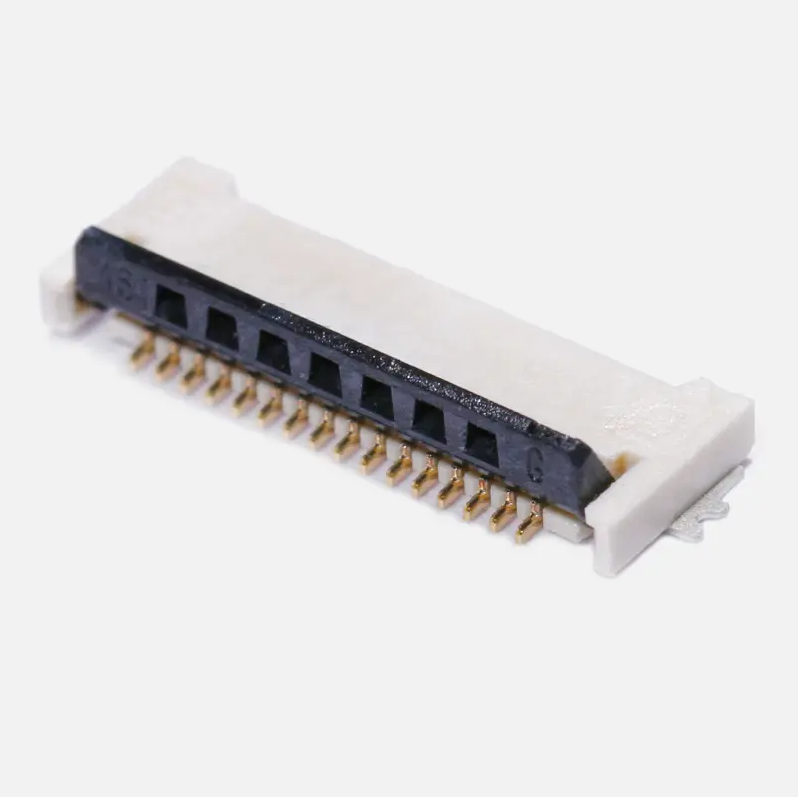
Different connector pitches provide different balances between size, assembly difficulty, and application requirements.
Smaller pitch connectors are usually selected for highly compact electronic products where PCB space is limited. Larger pitch connectors generally provide easier assembly and stronger mechanical tolerance.
| Feature | 0.3 mm Pitch | 0.5 mm Pitch | 1.0 mm Pitch |
| Connector size | Very compact | Compact | Larger |
| Contact density | Highest | Medium-high | Lower |
| Assembly difficulty | Higher | Moderate | Easier |
| PCB space requirement | Minimal | Balanced | More space needed |
| Typical applications | Ultra-thin devices, precision electronics | Consumer electronics, displays, industrial equipment | Larger electronic systems |
A 0.5 mm pitch connector often provides a practical balance between miniaturization and manufacturing reliability. It offers higher density than 1.0 mm pitch connectors while being easier to assemble compared with 0.3 mm pitch solutions.
For applications requiring even smaller designs, engineers may consider a 0.3 mm pitch FPC connector when PCB space is extremely limited.
Contact direction is another important factor when selecting an FFC/FPC connector. Different contact structures determine how the flexible cable is inserted and how the electrical interface is established.
Top contact connectors are designed with terminals located on the upper side of the connector. They are suitable for PCB layouts where the cable connection direction requires contact from the top surface.
Bottom contact connectors place the contact interface on the lower side, which may better match certain PCB structures.
Dual contact connectors provide flexibility because they support contact on both sides of the cable. This design can simplify product design and improve compatibility with different assembly configurations.
The choice between top, bottom, and dual contact depends on:
PCB layout requirements
Cable insertion direction
Available installation space
Product mechanical structure
For manufacturers requiring flexible installation options, dual contact solutions can provide additional design freedom.
Connector height, pin count, and cable specifications directly affect compatibility between the connector and the overall electronic system.
Connector height determines how the component fits within the product structure. Low-profile connectors are commonly used in thin devices where internal space is limited.
Pin count should match the number of required signal connections. Choosing too few pins may limit functionality, while excessive pin numbers may increase unnecessary cost and PCB complexity.
When selecting a connector, engineers should evaluate:
Required number of electrical contacts
FFC/FPC cable thickness
PCB mounting space
Mechanical clearance
Operating environment
The cable itself is also an important consideration. A compatible FFC cable 0.5 mm pitch must match the connector pitch, contact position, and mechanical specifications to ensure reliable assembly.
Different industries have different requirements for FFC/FPC connectors. Selecting the right connector depends on product design, environmental conditions, and performance expectations.
| Application | Recommended Considerations |
| Display modules | Compact size, high pin count, stable signal transmission |
| Consumer electronics | Low profile, lightweight design, reliable repeated assembly |
| Industrial equipment | Durability, mechanical stability, long service life |
| Testing devices | Accurate positioning and dependable connections |
For engineers designing new products, connector selection should happen early in the development process. Considering cable compatibility, contact direction, and mechanical requirements helps avoid redesign costs later.
Rtench provides customized FFC/FPC connector solutions with different pitches, heights, and contact structures to support various application needs.
Selecting an FFC/FPC connector requires balancing electrical performance, mechanical requirements, and manufacturing conditions.
Important factors include:
Application requirements: Understand signal type, operating environment, and product lifespan expectations.
Connector specifications: Match pitch, pin count, height, and contact direction with the PCB design.
Supplier capability: Evaluate customization support, manufacturing precision, and quality control.
Working with an experienced connector manufacturer helps engineers optimize designs and improve production reliability.
Rtench specializes in precision connector manufacturing and supports customers with reliable FFC/FPC solutions for consumer electronics, industrial applications, and customized projects.
Choosing the right FFC/FPC connector requires careful consideration of pitch size, contact structure, cable compatibility, and application requirements. A 0.5 mm pitch connector provides a balanced solution for many compact electronic devices by combining space efficiency and reliable performance. By selecting suitable specifications and partnering with an experienced manufacturer like Rtench, engineers can achieve stable connections and improve product design reliability.
Connector pitch refers to the distance between the centers of adjacent contacts in an FFC/FPC connector.
0.5 mm pitch provides a good balance between compact design, signal density, and manufacturing reliability.
The choice depends on PCB layout, cable insertion direction, and product structure requirements.
No. The cable pitch must match the connector pitch to ensure proper electrical contact.
Not necessarily. Smaller pitches save space but may require more precise manufacturing and assembly.
Companies should evaluate product quality, customization ability, manufacturing precision, and technical support.
Pogo Pin Connectors Related News